
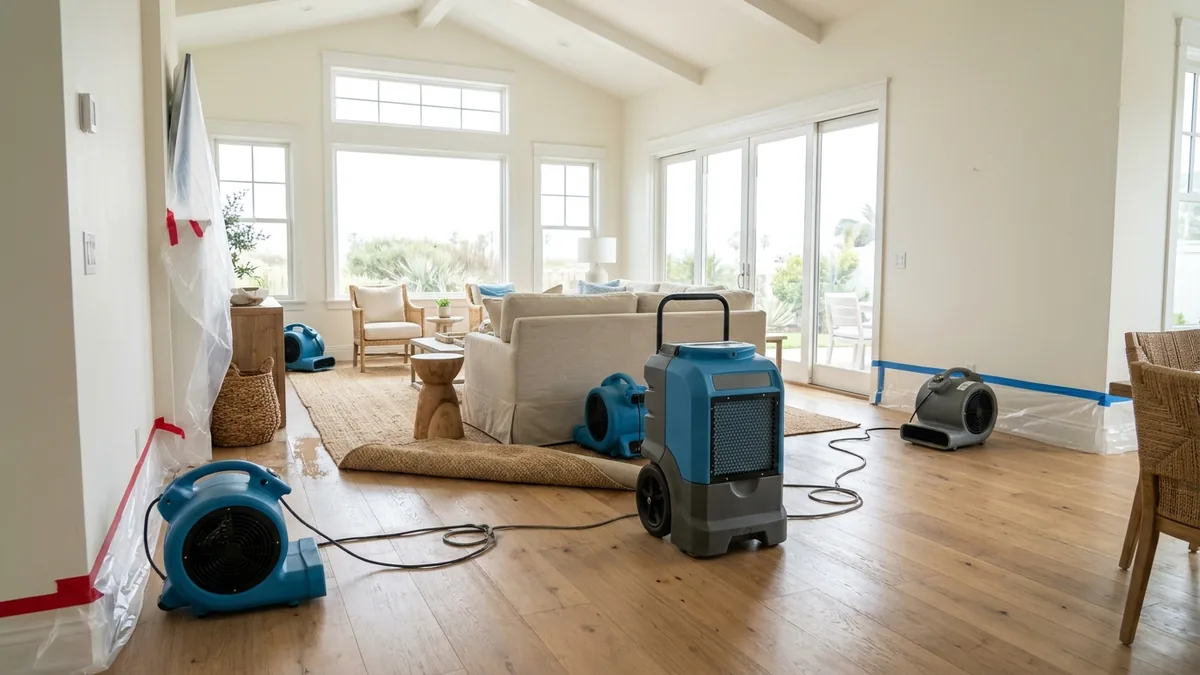
Cardiff-by-the-Sea's persistent coastal marine layer keeps outdoor relative humidity between 65% and 85% much of the year, stalling natural evaporation after a leak. Professional structural drying and dehumidification counters this by sealing the wet area into a closed chamber and running commercial LGR dehumidifiers that drop indoor vapor pressure far below coastal outdoor air.
Every coastal North County homeowner loves throwing open the sliding glass doors on a mild 68-degree morning in Cardiff-by-the-Sea. For everyday living, the ocean breeze off Swami's and Cardiff Reef is the reason people move to ZIP 92007. After a burst supply line, overflowing tub, or under-slab leak, however, that exact same Pacific breeze becomes your home's worst enemy.
Homeowners in the Walking District and Composer District frequently assume that sunny Southern California weather dries wet floors naturally in a day or two. In reality, coastal air carries a heavy invisible load of water vapor—especially during May Gray, June Gloom, and autumn evening fog rolling inland across San Elijo Lagoon. Understanding how psychrometrics (the physics of air, temperature, and moisture) behaves along the coast explains why DIY fan setups leave hidden moisture trapped behind stucco walls and baseboards.
What Is Vapor Pressure—and Why Does Coastal Air Stall Evaporation?
Evaporation only happens when water vapor moves from a high-pressure wet surface into lower-pressure dry air. When outdoor marine-layer air enters a flooded living room, the air is already carrying a high concentration of moisture measured in grains per pound (GPP). Because the gap between wet drywall and humid coastal air is narrow, evaporation slows to a crawl.
Think of the air in your house like a sponge. Dry desert air in inland California is a wrung-out sponge that absorbs water rapidly from wet oak planks and framing. Marine-layer air drifting across Highway 101 is already two-thirds full. Blowing that damp air across wet baseboards with a household box fan moves air around, yet the sponge cannot hold much more water. Worse, if the outdoor air cools down after sunset, its relative humidity spikes even higher, allowing drywall paper and subfloor plywood to reabsorb moisture overnight.
In coastal water damage restoration in Cardiff-by-the-Sea, independent mitigation technicians measure three numbers every single day: temperature, relative humidity (RH), and specific humidity (GPP). By comparing indoor GPP against outdoor coastal GPP, they can prove mathematically whether an open-window approach would help or harm your structure. Along the 92007 shoreline, a closed drying system wins almost every month of the year.
Coastal Marine-Layer Drying vs. Closed-Chamber LGR Drying
The table below illustrates why independent restoration contractors seal off wet rooms rather than ventilating them with ocean air.
| Drying Factor | Open Windows + Box Fans (DIY) | Closed Chamber + Commercial LGR System |
|---|---|---|
| Ambient Humidity Control | Fluctuates from 60% afternoon to 85%+ overnight marine layer | Held steadily below 35%–45% RH continuously 24 hours a day |
| Grains Per Pound (GPP) | Typically 75–95 GPP near San Elijo Lagoon and Hwy 101 | Reduced below 35–45 GPP inside the drying chamber |
| Bound Moisture in Framing | Surface feels dry while wood studs stay above 18% moisture content | Steady vapor-pressure draw pulls bound moisture down to 10%–13% dry standard |
| Secondary Damage Risk | High risk of musty odors, cupping hardwood, and microbial growth after 24–48 hrs | Controlled evaporation minimizes swelling, delamination, and secondary damage |
| Verification Method | Hand-touch guesswork (unreliable on painted drywall or tile) | Daily calibrated pin/pinless moisture meter logs & thermal scans |
Why Stucco Exteriors & Coastal Vapor Barriers Complicate Wall Drying
Most Cardiff-by-the-Sea homes are clad in exterior stucco over building paper and plywood sheathing, which restricts outward drying. When water from a burst pipe or upstairs bathroom leak enters an exterior wall cavity, moisture cannot evaporate easily through the stucco and weather-resistive barrier on the outside.
That means 100% of the trapped water must exit toward the interior of the home. If interior latex semi-gloss paint seals the drywall face while stucco seals the exterior, the wooden studs and fiberglass batt insulation sit inside a humid sandwich. In homes throughout Cardiff Cove & Park Place and Solana Beach, leaving wet fiberglass insulation inside a closed exterior wall almost guarantees lingering dampness for weeks.
To solve this without unnecessary demolition, independent restoration technicians first perform thermal imaging and moisture-meter probing. When water is clean (Category 1) and insulation is absent or minimally affected, technicians may detach baseboards and drill discreet weep holes behind the trim line to inject dry air directly into the cavity. When fiberglass batts are soaked or exterior stormwater entered the wall, performing a clean 24-inch drywall flood cut removes the wet sponge so commercial air movers can dry the framing thoroughly.
Step-by-Step: How Pros Establish a Coastal Drying Chamber
Effective structural drying follows a strict sequence rather than simply dropping fans in a hallway. Skipping step one—physical water removal—doubles drying time and drives up equipment costs.
- Aggressive Liquid Extraction First: Removing standing water via emergency water extraction is hundreds of times more energy-efficient than evaporating it. Weighted rovers and truck-mount wands pull free water from carpet pad, tile grout, and concrete seams before dehumidifiers even switch on.
- Containment of the Wet Zone: Technicians install 6-mil poly sheeting zipper walls if only one wing of the house is wet. Shrinking the cubic footage of air being conditioned lets LGR dehumidifiers pull GPP down far faster.
- Balanced Airflow Across Wet Surfaces: Low-profile centrifugal air movers are angled along baseboards and floors to break up the microscopic boundary layer of humid air clinging to wet materials, pushing moisture into the air stream.
- Continuous LGR Dehumidification: Low-grain refrigerant (LGR) units—such as Dri-Eaz or Phoenix commercial models—pre-cool incoming air before it hits the evaporator coil, allowing them to keep wringing water out of the air even after indoor relative humidity drops below 40%.
- Daily Moisture-Meter Verification: Technicians return every 24 hours to log indoor temperature, RH, GPP, and direct wood/drywall moisture content against an unaffected dry reference wall in the same home.
Microclimate Differences Across Cardiff-by-the-Sea Neighborhoods
Not every street in ZIP 92007 dries at the exact same speed. Local geography creates subtle microclimates that experienced North County crews account for when sizing equipment:
- Walking District & Coast Hwy 101: Sitting within a few hundred yards of breaking surf, cottages and duplexes here experience the highest daytime and nighttime salt-air humidity, often requiring higher-capacity LGR units.
- San Elijo Lagoon Corridor: Wetland evaporation from the ecological reserve elevates overnight humidity even on clear nights when skies above I-5 are dry.
- Composer District Hillsides: Elevated west-facing lots catch direct onshore breezes and afternoon sun; west-facing rooms warm up quickly in the afternoon, which technicians monitor carefully so hardwood floors do not dry too rapidly and crack.
- East of I-5 (Cardiff Cove, Park Place & Crestview Dr): Slightly warmer daytime temperatures help interior drying, though concrete slab foundations still release deep bound moisture slowly over 4 to 5 days.
Diagnostic Checklist: 6 Signs Your Home Is Still Holding Hidden Moisture
If you tried drying a small leak yourself—or if a repair crew pulled equipment without showing you moisture readings—watch for these six warning signs over the next two weeks:
- Earthy or musty odor strongest in the morning after doors and windows have been closed overnight.
- Cupping hardwood planks where the edges of individual boards sit slightly higher than the center.
- Swollen MDF baseboards showing hairline cracks along the top caulk bead or soft, spongy corners.
- Cool patches on lower drywall noticeable to the back of your hand compared to dry walls in the same room.
- Interior window condensation appearing in the previously flooded room when other rooms remain clear.
- Peeling paint or efflorescence (chalky white mineral powder) emerging on garage concrete or stucco bases.
When to Call for Professional Structural Drying in Cardiff
If water has soaked into carpet padding, traveled beneath hardwood or luxury vinyl planks, or wicked into drywall above the baseboard line, the 24-to-48-hour coastal window starts immediately. You can preview equipment and drying-duration variables using our Cardiff water damage cost calculator, or call our free referral line at (760) 555-0194 to connect with an independent local restoration specialist who can perform a moisture-meter inspection today.
Frequently Asked Questions
Outdoor coastal air in Cardiff-by-the-Sea routinely holds 70% to 85% relative humidity during overnight marine layers and May Gray or June Gloom mornings. Letting humid ocean air inside raises indoor grains per pound (GPP), reducing the vapor-pressure differential needed to pull bound moisture out of wet drywall and hardwood.
Most residential structural drying jobs west of I-5 take 3 to 5 days using commercial low-grain refrigerant (LGR) dehumidifiers and high-velocity air movers. Concrete slab moisture or double-layer drywall can extend drying by 1 to 2 days.
Independent restoration technicians typically aim to bring the drying chamber below 40% to 45% relative humidity—and under 40 to 50 grains per pound of moisture—so wet wood framing releases bound water steadily without warping.
Consumer dehumidifiers remove far fewer pints per day and lose efficiency sharply once indoor humidity drops below 50%. Commercial LGR units continue pulling moisture out of air down to very low humidity grains, which is essential to dry wood studs and subfloors completely.